Sunday, March 2, 2014
Pellet de madera
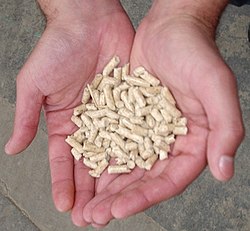
El pellet es un tipo de combustible granulado alargado a base de madera. Pellet tiene una traducción directa al castellano como pella que sería más apropiada para nombrar este material. También sirve como suelo para hámsters.El pellet se fabrica mediante prensado de serrín donde la propia lignina hace de aglomerante. No se necesita ni pegamento ni ninguna otra sustancia más que la misma madera. Este proceso les da una apariencia brillante como si estuviesen barnizados y los hace más densos.
 La principal desventaja es que no hay una forma de suministro regular, como el gas o el gasoil en España. Sin embargo, en Andalucía a la hora de montar una caldera de biomasa mediante la Agencia Andaluza de Energía se establece un contrato por el cual queda incentivado parte de la inversión y el suministro de este combustible es obligatorio durante los 5 primeros años.
También ocupa más lugar que el gasoil, por lo que hace falta más sitio para almacenarlo o reponer las existencias más veces.
Existen distribuidores de pellets a nivel nacional (España) que pueden asegurar el suministro de pellet por contrato. El espacio sí es un problema que hay que sopesar.
Respecto a otras formas tradicionales de biomasa como la leña o las astillas tiene algunas desventajas:
A veces se tiene acceso a leña a un precio muy bajo o gratuito.
Las astillas tienen una densidad energética menor. No están prensados ni tienen un granulado uniforme. Pueden reunir casi todas las ventajas de los pellet (automatización, aprovechamiento energético…) y las astillas son mucho más fáciles de producir a partir de restos de poda u otros desechos madereros. Solo es necesario una trituradora adecuada y se evita el proceso de prensado y no se necesita calor.Esta necesidad de procesado extra de los pellets los hace más costosos de fabricar económica y energéticamente.Si el pellet pasa por varios sinfines de alimentación se deshace un poco, lo que crea serrín que obtura o dificulta a veces la alimentación de la caldera.La combustión del pellet tiene un mayor consumo de aire, por lo que se hace necesaria una mayor ventilación de la sala de calderas de biomasa que una sala de calderas de gas, gasoil u otro tipo de combustible.Como en toda combustión se crean residuos, lo cual implica una cierta cantidad apreciable de ceniza, que según el tipo de pellets que se quemen varía en volumen.También existen varios tipos de pellet, según su procedencia (de olivo, álamo, podas de árboles de ciudad, etc.) y de la zona geográfica, lo que hace que el poder calorifico varíe y, en consecuencia, no sea apropiadda la misma regulación en un sitio que en otro.
La principal desventaja es que no hay una forma de suministro regular, como el gas o el gasoil en España. Sin embargo, en Andalucía a la hora de montar una caldera de biomasa mediante la Agencia Andaluza de Energía se establece un contrato por el cual queda incentivado parte de la inversión y el suministro de este combustible es obligatorio durante los 5 primeros años.
También ocupa más lugar que el gasoil, por lo que hace falta más sitio para almacenarlo o reponer las existencias más veces.
Existen distribuidores de pellets a nivel nacional (España) que pueden asegurar el suministro de pellet por contrato. El espacio sí es un problema que hay que sopesar.
Respecto a otras formas tradicionales de biomasa como la leña o las astillas tiene algunas desventajas:
A veces se tiene acceso a leña a un precio muy bajo o gratuito.
Las astillas tienen una densidad energética menor. No están prensados ni tienen un granulado uniforme. Pueden reunir casi todas las ventajas de los pellet (automatización, aprovechamiento energético…) y las astillas son mucho más fáciles de producir a partir de restos de poda u otros desechos madereros. Solo es necesario una trituradora adecuada y se evita el proceso de prensado y no se necesita calor.Esta necesidad de procesado extra de los pellets los hace más costosos de fabricar económica y energéticamente.Si el pellet pasa por varios sinfines de alimentación se deshace un poco, lo que crea serrín que obtura o dificulta a veces la alimentación de la caldera.La combustión del pellet tiene un mayor consumo de aire, por lo que se hace necesaria una mayor ventilación de la sala de calderas de biomasa que una sala de calderas de gas, gasoil u otro tipo de combustible.Como en toda combustión se crean residuos, lo cual implica una cierta cantidad apreciable de ceniza, que según el tipo de pellets que se quemen varía en volumen.También existen varios tipos de pellet, según su procedencia (de olivo, álamo, podas de árboles de ciudad, etc.) y de la zona geográfica, lo que hace que el poder calorifico varíe y, en consecuencia, no sea apropiadda la misma regulación en un sitio que en otro.

Πέλλετ ξύλου
Τα πέλλετ ή συσσωματώματα ξύλου είναι είδος φιλικού προς το περιβάλλον καυσίμου που προέρχεται από ξύλο ή από βιομάζα, γενικά. Κατασκευάζονται κυρίως από πριονίδι ή άλλα απόβλητα από πριστήρια και μονάδες επεξεργασίες ξύλου (π.χ. θρύμματα ξύλου, ξακρίδια κ.λπ.). Σε αρκετές περιπτώσεις παράγονται και από εναλλακτικές πρώτες ύλες βιομάζας, όπως είναι το [πυρηνόξυλο], οι ενεργειακές καλλιέργειες, τα κλαδέματα δέντρων (π.χ. ελιάς και τα υπολείμματα καλλιεργειών
 Η διαδικασία παραγωγής των "πέλλετ ξύλου" περιλαμβάνει διαδοχικά τα ακόλουθα στάδια [2]: 1) την αποθήκευση των πρώτων υλών [βιομάζας/βιομάζα] σε καθαρό και στεγνό χώρο 2) τη ξήρανση της ώστε να μειωθεί η περιεκτικότητά της σε υγρασία 3) τον τεμαχισμό και άλεση της 4) τη συμπίεση της σε ειδικές [πρέσες/πρέσα] 5) τη ψύξη και την κοσκίνιση του παραγόμενου πέλλετ 6) την αποθήκευση του τελικού εναλλακτικού καυσίμου που παράγεται σε ασφαλές μέρος. Βασική προϋπόθεση σε όλη αυτή τη διαδικασία είναι η πρώτη ύλη να αποτελείται αποκλειστικά από καθαρό ξύλο, χωρίς προσμίξεις από χημική ουσία (π.χ. βαφές, βερνίκια, κ.λπ.) Παράλληλα, κατά την παραγωγή τους δεν χρησιμοποιούνται καθόλου χημικά, καθώς η συγκολλητική ουσία που τους χαρίζει τη συμπαγή τους μορφή, είναι η λιγνίνη, μια φυσική ουσία που περιέχεται στο ξύλο. Η διαδικασία παραγωγής του πέλλετ συντελεί στην παραγωγή υψηλής ποιότητας προϊόντος είναι απαραίτητο να ελέγχεται πλήρως η παραγωγική διαδικασία. Οποιαδήποτε μεταβολή στις συνθήκες παραγωγής του πέλλετ (π.χ. μη επαρκής ξήρανση) έχει ως συνέπεια την παραγωγή κατώτερης ποιότητας προϊόντος, με χαμηλότερη ενεργειακή απόδοση.

Friday, February 28, 2014

Pellet fuels are heating fuels made from compressed biomass.
Wood pellets are the most common type.
A form of wood fuel, wood pellets are generally made from compacted sawdust or other wastes from sawmilling and other wood products manufacture,.[1] Other woody biomass sources include palm kernel shell, coconut shell, and whole-tree removal or tree tops and branches leftover after logging and which otherwise help replenish soil nutrients.[2]

As well grasses can also be pelletized, creating grass pellets. Pellets are manufactured in several types and grades as fuels for electric power plants, homes, and other applications in between.[3] Pellets are extremely dense and can be produced with a low moisture content (below 10%) that allows them to be burned with a very high combustion efficiency.[4] Further, their regular geometry and small size allow automatic feeding with very fine calibration.
They can be fed to a burner by auger feeding or by pneumatic conveying. Their high density also permits compact storage and rational transport over long distance. They can be conveniently blown from a tanker to a storage bunker or silo on a customer's premises.[5]
A broad range of pellet stoves, central heating furnaces, and other heating appliances have been developed and marketed since 1993.[citation needed]
 |
http://www.interscala.gr |
With the surge in the price of fossil fuels since 2005, the demand for pellet heating has increased in Europe and North America, and a sizable industry is emerging. According to the International Energy Agency Task 40, wood pellet production has more than doubled between 2006 and 2010 to over 14 million tons.[6] In a 2012 report, the Biomass Energy Resource Center says that it expects wood pellet production in North America to double again in the next five years.
Subscribe to:
Posts (Atom)